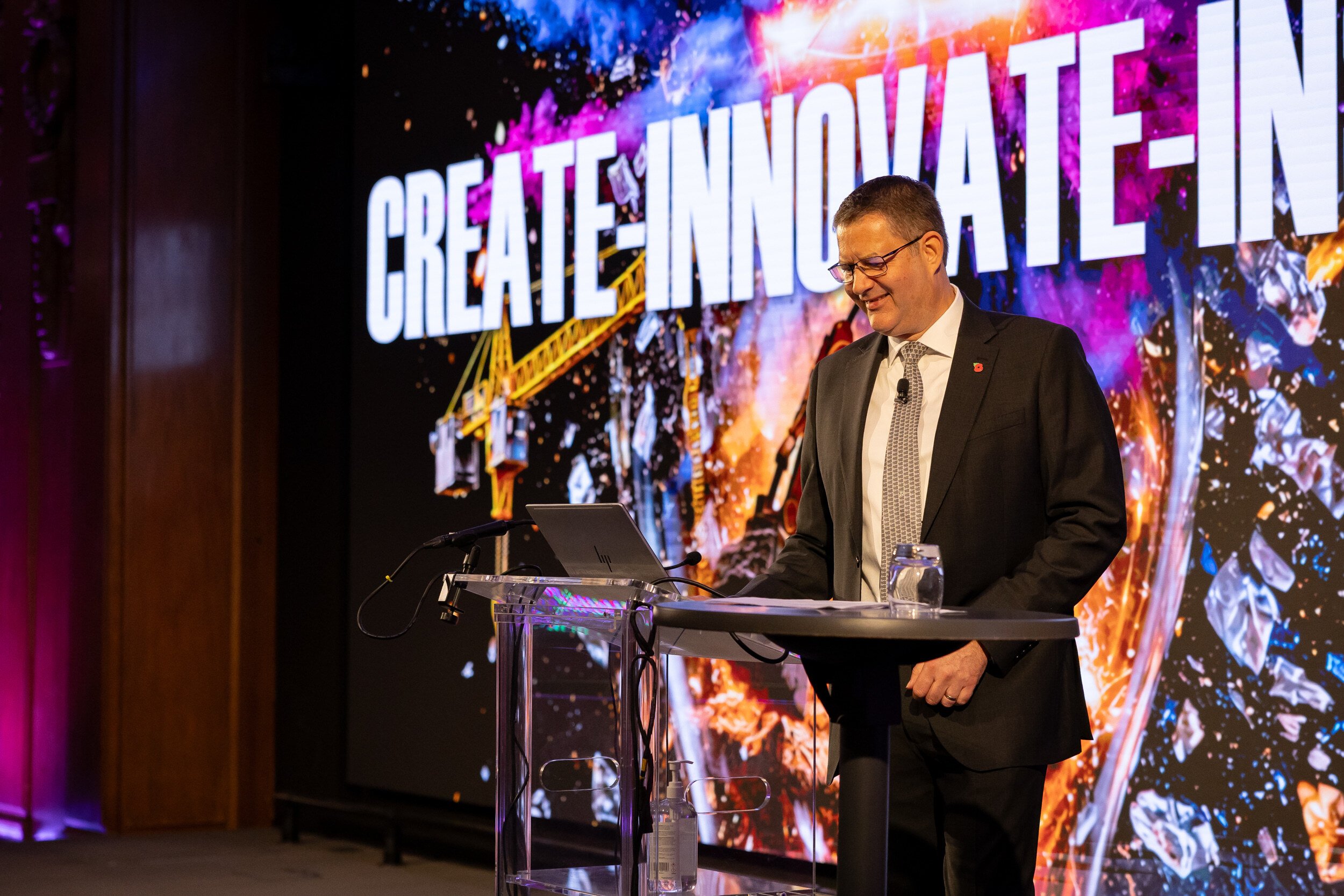
Europe's construction equipment industry has the engineering expertise, manufacturing strength and ambition to compete on the world stage. Protecting that position will demand fresh thinking, investment and a willingness to challenge established ways of working. These themes ran through CECE Congress 2026, from industrial policy and global trade to design, skills and the human capacity to adapt.
This first of our two-part Congress reports covers the opening evening and 28 October plenary at IET Savoy Place, London. The CEA (Construction Equipment Association) hosted the event on behalf of the CECE (Committee for European Construction Equipment). Held every two years in the country of the serving CECE President, the 2026 Congress came to the UK under JCB's Phil Layton. Around 200 delegates gathered under the theme Create, Innovate, Inspire.
Proceedings began on Tuesday 27 October with welcome drinks and dinner at IET Savoy Place. Against the backdrop of views across London, the evening gave delegates time to reconnect with colleagues, meet new contacts and exchange ideas before the main conference programme.
Opening the plenary proceedings on Wednesday 28 October, CECE Secretary General and moderator Riccardo Viaggi asked delegates how optimistic they felt about the sector’s future. Their average score was 7.7 out of ten, an encouraging starting point for a day that moved from the geopolitical outlook and industrial policy to creativity, skills and the human capacity to adapt.
CECE President Phil Layton put Europe’s manufacturing position into perspective. Its construction equipment sector comprises around 1,200 companies and accounts for approximately 20% of global equipment output. After the sharp market downturn of 2024, signs of recovery emerged in 2025. But longstanding leadership could not protect manufacturers from increasingly determined international competition, sometimes supported by state subsidies.
Layton highlighted the importance of a competitive European market, policies that encourage investment and a regulatory environment that supports innovation. Ambitious environmental and digital objectives remain important, he argued, but legislation must also be practical and proportionate, allowing manufacturers the flexibility to develop new technologies.
For CEA members, the importance of continued co-operation between the UK and European construction equipment industries was particularly relevant. With manufacturers operating across closely connected markets and supply chains, maintaining a constructive relationship on technical and regulatory matters remains important. Layton also acknowledged the strong working relationship between CECE and the CEA, reflecting the shared interests of both associations in supporting the industry's future.
A Congress poll showed an overwhelming majority expected the UK and EU to have a much closer industrial relationship within five years. Lord Richard Harrington, Chair of Make UK and a former UK business minister, explained why the commercial case for co-operation was strong, even where politics made progress difficult.
Harrington warned that manufacturers could easily direct their next investment elsewhere. Drawing on his foreign direct investment review, informed by around 200 companies and investors, he identified planning delays, visa difficulties, slow approvals and skills shortages as barriers. He described an AstraZeneca example involving a proposed £1.2 billion investment and a request for £18 million in government support. The request was less about money than demonstrating partnership with government, but lengthy approvals undermined that ambition.
He also questioned the proposed EU Industrial Accelerator Act. A narrow definition of what qualifies as ‘made in Europe’, he argued, could disadvantage UK production and disrupt European businesses that rely on British components. He wanted the UK recognised within Europe's interconnected manufacturing system, while warning that healthy order books offered little comfort to manufacturers facing pressure on margins.
Professor Joe Nellis CBE, Emeritus Professor of Global Economy at Cranfield School of Management, widened the view. Influence was shifting between the United States, Europe and China, while India's growth would create opportunities. Europe remained a weak link among major economic regions, he suggested, constrained by energy costs, inflation, expensive finance and poor productivity.
Artificial intelligence brought both opportunity and disruption. Nellis argued that businesses could experience more change in five years than in the previous fifty, with huge investment in AI and the infrastructure to power it. He advised manufacturers to diversify suppliers, protect energy security and liquidity, and invest in automation and skills where gains could be measured. He also saw opportunity in infrastructure spending: “Investment is the engine of growth.” The challenge was to lift their “nose off the desk” and plan beyond immediate targets.
Automotive designer and design strategist Koorosh Shojaei showed how innovation can deliver business value. His team improved a commercial truck's range by 10% by changing its front, roof spoiler, sides and underbody while retaining the cab and chassis. The goal was better total cost of ownership, rather than styling for its own sake.
For construction equipment manufacturers, his point was that breakthroughs can come from improving existing machines. Bringing designers, engineers and production specialists together early can improve energy efficiency, operator experience, visibility, maintainability and modularity without requiring every development project to begin from zero.
Jason Bevan, founder and Managing Director of Content Creator Studios and a former Warner Bros. Pictures creative executive, challenged delegates from another direction. Big-budget films also operate with deadlines, regulations and commercial targets. Creativity can coexist with discipline, he argued, provided organisations distinguish essential constraints, such as safety, from habits that no longer serve a purpose.
Using the unconventional design of the Batmobile as one example, Bevan argued for bringing outside perspectives into established teams and giving ambitious ideas room to develop. “The danger to your business is conformity. It’s blandness and sameness,” he warned. The opportunity extends beyond machine design to services, customer relationships and ways of working.
Samantha Rennison KPM, former Chief Superintendent in UK policing and founder of The Experience Effect, highlighted the consequences of unexamined assumptions. Already qualified female firearms officers were struggling to pass an assessment for specialist protection roles because their trousers sat higher on the waist, slowing access to concealed firearms during a timed test.
The standard was not lowered. Candidates were shown why the test had been difficult and could practice with different trousers. Rennison said every female candidate passed the first qualification shoot following the changes. She also described recruitment exercises testing vehicle tyre knowledge when road policing increasingly needed investigation, analysis and communication. Her challenge was to recruit for tomorrow's needs rather than outdated assumptions.
That question carried into the afternoon. Ann Watson MBE, Chief Executive Officer of Enginuity Group, warned of a “talent timebomb”: an ageing workforce, shortages of experience, lengthy training periods and young people who lack clear guidance about technical careers. She set out Enginuity’s three Cs: cheerleading for engineering and manufacturing, championing SMEs' needs, and collaborating with employers, educators and partners to turn ideas into practical support.
A young people's panel added first-hand perspectives. Oliver Garnham, JCB Sales Specialist and recent degree apprenticeship graduate, spoke about earning while learning and reaching young people through schools and social media. Diana Novikova, Project Officer at Agoria, and Ole Thomas, apprentice mechatronics technician at Kiesel Group, contributed views from Belgium and Germany. The panel explored creative recruitment and ways to guide capable applicants who miss out on apprenticeships towards other opportunities. An audience poll suggested the sector must do more to engage the next generation.
The closing keynote, from former British Army officer and brain injury survivor Stewart Hill, brought the plenary programme to a deeply personal conclusion. Recalling the explosion in Helmand Province, Afghanistan, on 4 July 2009 that left him with a life-changing brain injury, he spoke of its impact on his life and family. A touching detail was the lucky crystal his daughter gave him, which he carries everywhere. It reflected his idea of finding a “Daily Diamond”, one good thing in every day, even in difficult circumstances.
His presentation, Enduring Performance, explored how people can meet today’s cognitive demands while building their capacity for tomorrow. Drawing on his recovery, Hill introduced his MPG model: Minimise Cognitive Friction, Pursue Brain Enrichment and Generate Collective Strength. In practice, that means reducing unnecessary mental strain and bureaucracy, encouraging experiences that stimulate learning and creativity, and bringing people with different abilities together around a common purpose.
Hill is exploring how the MPG approach can translate into business and has invited feedback on its potential application in organisations. He challenged delegates to take three actions over the following 30 days: remove one avoidable source of friction, create an opportunity for learning and bring colleagues together to solve a shared problem. Enduring performance, he argued, comes from deliberate actions repeated over time.
The day continued with the Congress Gala Dinner and a cruise along the River Thames. The London skyline provided a memorable setting for delegates to continue conversations, strengthen relationships and make new connections away from the formal conference sessions.
From European industrial policy to how people are recruited and supported, the day pointed to the same conclusion. Manufacturers cannot control every global shock, but they can question accepted practices, improve the machines they already make and develop their people. That gives substance to the optimism expressed at the outset, and to the Congress theme of creating, innovating and inspiring.
Coming next, our second Congress report will turn to the Economic and Technical Forums on 29 October, exploring the market outlook, regulatory developments and technical challenges shaping the future of Europe’s construction equipment industry.
CECE and the CEA would like to thank all the speakers, delegates, sponsors and partners who contributed to the Congress. Their support helped bring together a programme of industry discussion, insight and debate in London.
Congress sponsors: JCB, ELITE Consultancy Network, Caterpillar, DLL, Safety Shield Global, CESAR, EZLEE, PlantWorx, Trackunit and Aptean. Media partners: KHL and Plant Planet.