Following a plenary day exploring Europe's industrial competitiveness, innovation and leadership, CECE Congress 2026 turned its attention to the technical, regulatory and economic realities facing the construction equipment industry.
The final day, held on 29 October at IET Savoy Place in London, featured dedicated Technical and Economic Forums, bringing together manufacturers, policymakers, engineers and market specialists to examine the issues shaping the sector's future.
The Technical Forum, supported by Safety Shield and moderated by CEA Senior Technical Advisor Dale Camsell, opened with a recorded presentation from Debborah Obafemi of the Greater London Authority. She outlined London's approach to reducing emissions from non-road mobile machinery, including the move to a minimum of Stage V standards across London from 2030 and the ambition for zero-emission machinery by 2040.
A practical example of construction decarbonisation came from Neesha Pandya and Michael Chester of the Lower Thames Crossing. The project had 31 electric machines in use by October 2026 and is targeting approximately 150 zero-emission machines by 2028, potentially making it one of the world's largest deployments of such equipment.
The team highlighted the importance of early energy planning, procurement, understanding costs and sharing lessons with the wider industry. Their message was to start small, build confidence and scale up, recognising that the transition requires changes in working practices as well as technology.
A technical panel featuring Maxwell Green of Make UK, Igor de Liefde of Hitachi Construction Machinery, Daniel Mansfield of BSI, Jason Ong of Komatsu Europe and Ryan Pratt of UKAS examined standards, regulatory alignment, conformity assessment and market surveillance. Discussions highlighted the need for fair competition, effective enforcement and international co-operation.
Simon Bailey, Head of Strategic OEM Integration at Safety Shield Global, provided an insight into the engineering challenges of integrating AI-powered human detection technology into construction equipment, using the Komatsu crawler excavator range as an example. His presentation demonstrated how moving from aftermarket technology to OEM integration demands extensive testing, supplier qualification, reliable machine communications and rigorous production controls.
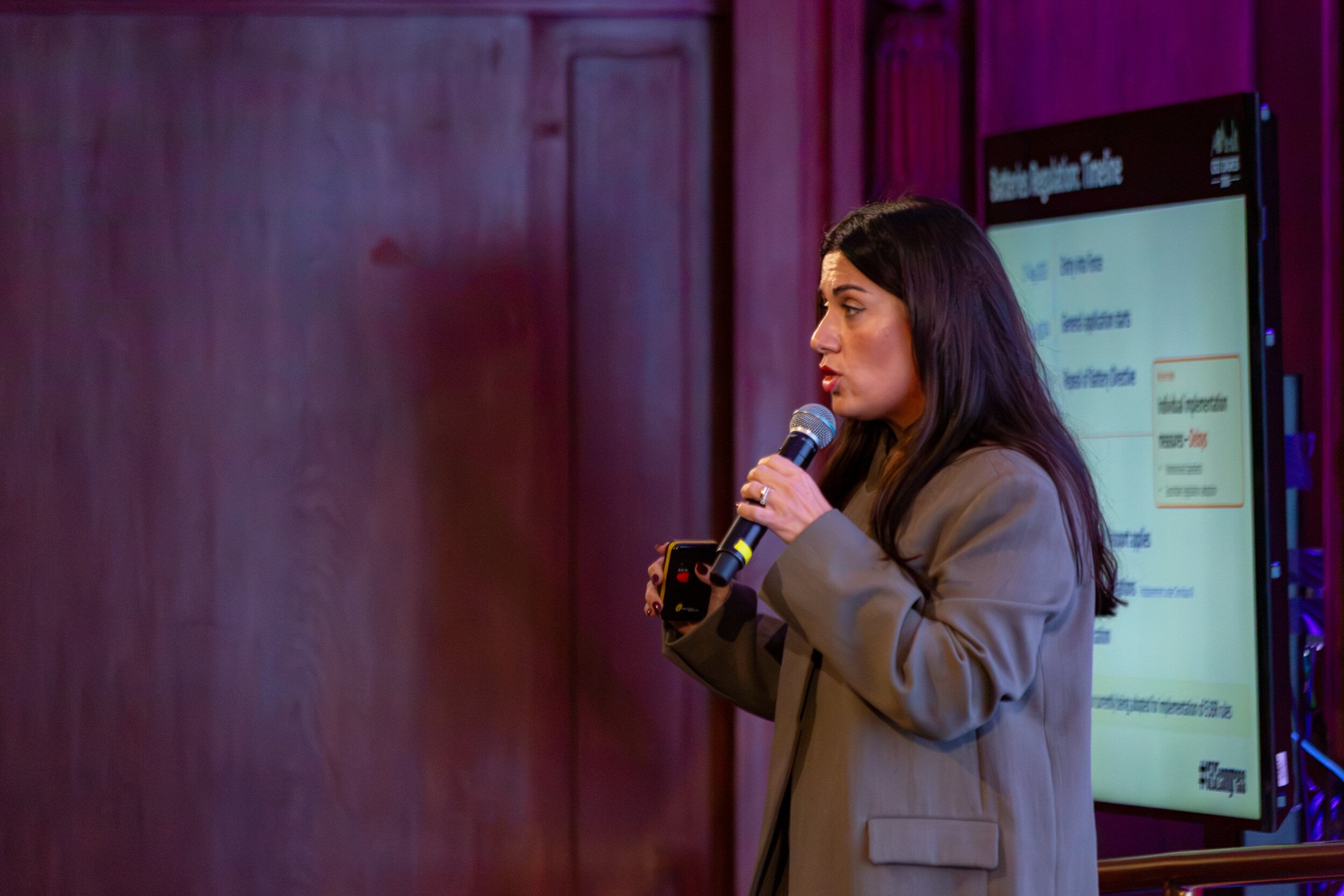
CECE policy managers Martina Griffo and Laura Fiumara delivered a wide-ranging regulatory update, including the EU Machinery Regulation, applicable from 20 January 2027, alongside developments in standardisation, market surveillance, cybersecurity, artificial intelligence, battery legislation and proposed PFAS restrictions. Their presentation highlighted the extensive technical and policy work CECE undertakes on behalf of the European construction equipment industry. With UK manufacturers and suppliers closely connected to European markets, that work remains particularly important to the CEA and its members.
The afternoon Economic Forum, supported by DLL and moderated by Rajesh Nath, Managing Director of VDMA India, examined global equipment markets, changing investment patterns and financing.
Chris Sleight, Managing Director of Off-Highway Research, presented the global construction equipment outlook, forecasting 3% growth in unit sales during 2026. Although the near-term recovery remains subdued, his longer-term analysis pointed towards a potential cyclical market peak of 1.4 to 1.5 million machines annually in the late 2020s or early 2030s.
DLL's Maja Josifovska, European Head of Sales for Construction, Transportation and Industrial Equipment, and Phil King, Global Head of Asset Management, explored how economic uncertainty is influencing purchasing and financing decisions. Their data showed an approved financing pipeline approximately 30% larger than a year earlier, although customers were taking longer to commit.
They also examined longer equipment holding periods, refurbishment, residual values and the role of flexible finance in supporting fleet renewal and access to new technology.
The forum concluded with a discussion on strengthening industrial relationships between India and Europe, featuring Dr Atul Deshmukh of JCB, Manuela Galante of Carmix and V. G. Sakthikumar of Schwing Stetter India.
Together, the sessions provided valuable insight into the technical, commercial and regulatory issues facing construction equipment manufacturers, reinforcing the importance of international collaboration and practical industry-led solutions.
Congress attendees have now received the full presentation slides by email, including detailed technical updates, regulatory information, market forecasts and supporting data.
CECE and the CEA thank the speakers, delegates, sponsors and partners who contributed to a successful Congress in London. Congress sponsors were platinum sponsor JCB, DLL, Safety Shield, Caterpillar, PlantWorx, ELITE Consultancy Network, EZLEE Industrial, CESAR, Trackunit and Aptean. The media partners were KHL and Plant Planet.
Looking ahead, CECE Congress will return in 2028, hosted in Germany, with the location and dates to be announced early in 2028.